Restaurant pad gas Midwest Boulevard
Cased bore per operator.
Midwest City, OK · Oklahoma County
Gas line boring in Midwest City with operator locate discipline — PE under Midwest commercial and post-war streets.
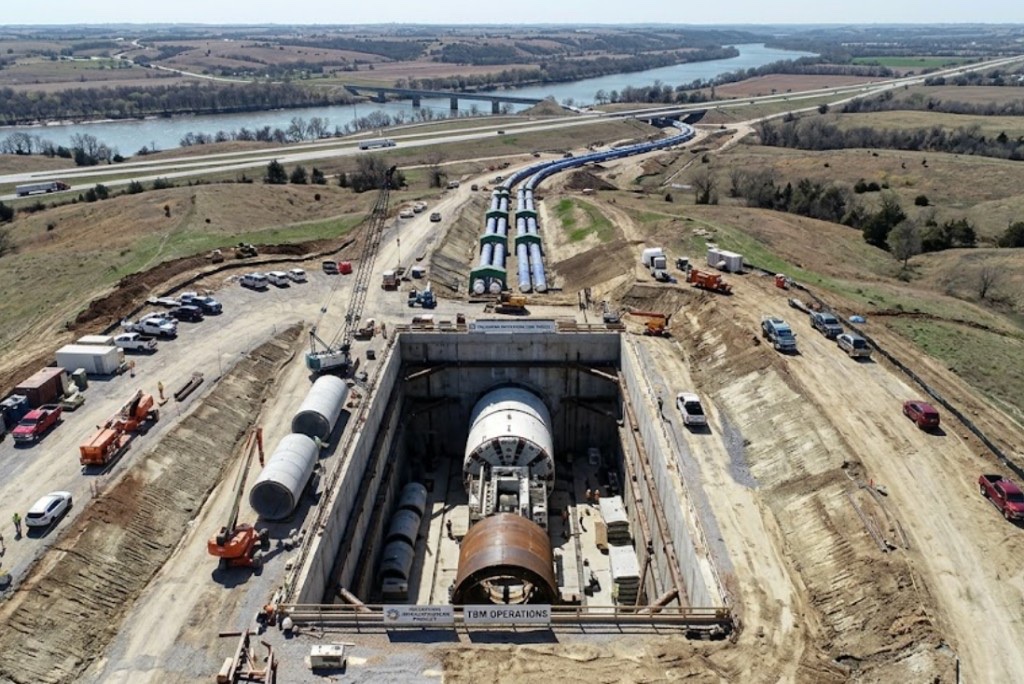
Gas line boring follows operator templates — locate standoff first. Homeowner through utility or assigned contractor.
I-40 industrial may combine casing and PE.
Real Oklahoma County angles — not generic statewide copy.
Cased bore per operator.
Operator-assigned to meter.
Engineer and operator sign-off.
Steel before PE.
Operator approval, locates, fusion, test.
Oklahoma County red clay with sandy lenses toward I-40 — shrink-swell heaves slab-on-grade laterals in post-war housing stock east of Tinker.
Midwest City bores encounter shrink-swell red clay with sandy lenses toward I-40 — post-war fill in older sections is homogenous clay with occasional rock sting on eastern limits. Slab-on-grade neighborhoods mean restoration cost drives method choice when berm and apron concrete cannot be sacrificed. Low areas near drainage outfalls add brief groundwater rise after spring storms.
Tornado alley exposure on the east OKC flank — spring hail and saturated red clay soften post-war slab neighborhoods; summer heat on long I-40 pulls.
Tornado and hail season drive calendar risk on the east metro — lightning holds stop rigs. Spring rain softens clay on post-war streets; summer heat affects long I-40 pulls. We communicate when weather should shift bore dates rather than risk frac-out along drainage lowlands.
City of Midwest City Engineering, Oklahoma County ROW, ODOT I-40 corridor, Tinker AFB installation coordination on select adjacent routes.
City of Midwest City permits street cuts and drive work inside limits. Oklahoma County ROW on rural east approaches. ODOT District 4 controls I-40 bores. Routes near Tinker may need installation or owner coordination beyond standard city permit — identified during scope, not assumed on every quote.
Paved ROW favors trenchless gas.
Operator fees, inspection, casing, soil, traffic control, testing, and emergency planning.
You share plans or describe the problem; we confirm alignment, depth, access, and which trenchless method fits Oklahoma soils.
Oklahoma One-Call ticket filed; two business days minimum before pits open unless your permit path differs. We pothole where marks conflict.
Bore plan, ODOT or city ROW permits, railroad agreements, and crossing engineering when the path leaves private property.
Compact spread for tight Edmond lots; larger HDD for I-35 or I-40 relocations — matched to length and diameter.
Steered pilot on design line, ream passes sized for your pipe or casing, fluid program tuned for clay or sand lenses.
HDPE fusion, steel casing, or multi-duct bundle pulled with tension and bend-radius monitoring.
Pressure test, mandrel, or survey records for owners, inspectors, and operators as spec requires.
Compact pits, replace sod or hardscape per scope, leave 811 ticket and locate map in your project file.
Through utility or assigned contractor.
Operator specs on bids.
Enhanced — no expired tickets.
Tooling review with operator.
24/7 — Emergency dispatch statewide. Tell us entry, exit, pipe size, and county — a bore specialist calls back with cost drivers, not a flat rate.
Scope your bore path
Step 1 of 2 — path, pipe, and city first