Emergency line, same number
Line strike, main break, or permit window closing — dispatch answers 24/7 when locates and safe access allow.
Oklahoma statewide
Long-span crossings under I-35, I-40, I-44, US-69, the North Canadian River, Arkansas River, and BNSF/UP corridors — HDD, casing, and agency coordination when open cut is off the table.
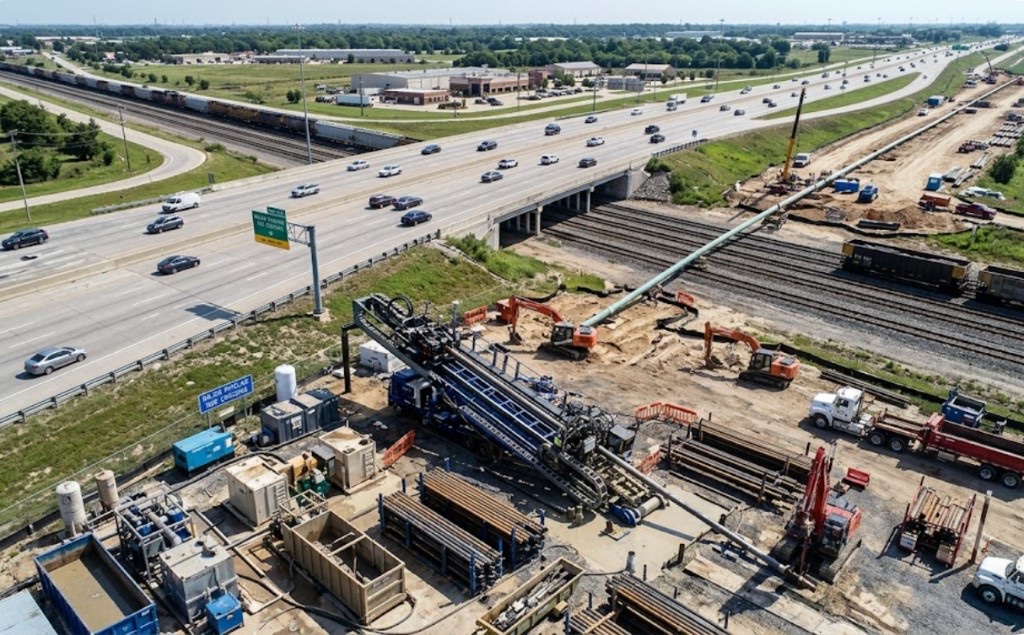
Long-span crossings under I-35, I-40, I-44, US-69, the North Canadian River, Arkansas River, and BNSF/UP corridors — HDD, casing, and agency coordination when open cut is off the table.
Engineering sets profile and casing plan. Larger rigs, staged reaming, and pullback monitoring complete the path. ODOT MOT, rail flagging, and environmental windows set the calendar.
Steel casing, HDPE, DIP, multi-duct — diameters per plan set.
Hundreds to thousands of feet with survey as-builts and agency inspection.
Major crossings rarely justify politically or economically — trenchless is default once alignment is approved.
Controlling permit defines notification beyond standard 811 — ODOT and railroad agreements lead.
Length, diameter, groundwater, environmental windows, flagging, engineering, inspection.
Get a Free Estimate →Shrink-swell clay, OG&E congestion, and ROW permits change the math — we scope before we mobilize.
Line strike, main break, or permit window closing — dispatch answers 24/7 when locates and safe access allow.
Send path, diameter, and county — we explain footage, rock, traffic control, and tap fees as drivers, not a menu price.
Oklahoma dig law, pothole conflicts, and expired tickets stop work — we document locates for commercial and municipal files.
Finished berms, brick walks, and tenant parking stay largely intact when HDD or casing fits the alignment.
District and scope drive weeks-to-months lead — assume permits before drill date.
Possible with engineered dividers and maintenance access — not ad hoc bundling.
North Canadian, Arkansas, Cimarron, and Red River corridors each carry different floodplain and access rules.
HDD uses a steerable drill head to create an underground path, then pulls pipe or conduit through without a continuous surface trench. It is the standard way to cross driveways, parking lots, highways, and waterways when restoration costs matter.
Quotes depend on footage, pipe size, red clay or rock, groundwater, traffic control, and how many utilities share the corridor — we do not publish a per-foot rate. Send your alignment and we will break down the cost drivers on a free estimate.
24/7 — Emergency dispatch statewide — (512) 838-3643
Scope your bore path
Step 1 of 2 — path, pipe, and city first