
Trunk sewer under West Main utility fill
Deep gravity with tight tolerance — shafts avoid continuous trench through OG&E congestion.
Norman, OK · Cleveland County
Microtunneling for Norman municipal trunks and Little River outfalls — pipe jacking when HDD cannot hold gravity grade in wet Cleveland County approaches.
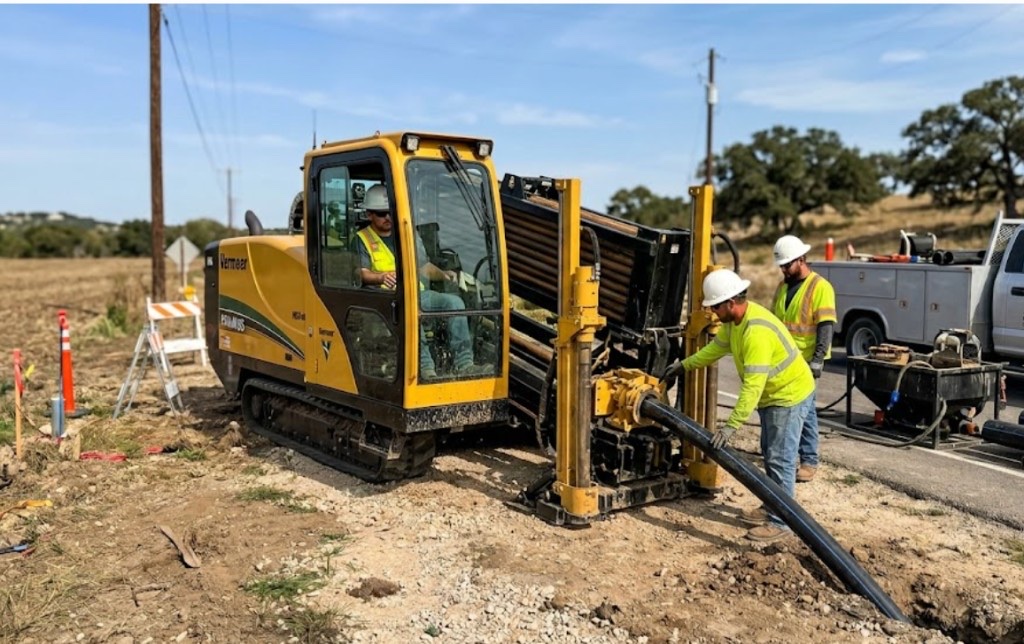
Tunneling and TBM work in Norman targets deep gravity sewer and large outfalls where steerable HDD cannot meet elevation tolerance near Little River and Lake Thunderbird approaches. Shaft footprints beat open trenching trunk lines through campus-adjacent utility fill.
Floodplain and bank stability on river approaches push engineers toward sealed-face mining — trenching through trail and park edges rarely clears review. Driveway-scale laterals stay on HDD.
I-35 interceptor work may layer ODOT coordination with city inspection — microtunneling is trunk-scale, not berm lateral scope.
Real Cleveland County angles — not generic statewide copy.
Deep gravity with tight tolerance — shafts avoid continuous trench through OG&E congestion.
Wet approach favors mined crossing with engineered shafts over open cut in saturated clay.
RCP jacking with settlement monitoring adjacent to warehouse pads.
City mandrel inspection on laser-guided mining — traffic control on Main arterials.
Norman microtunneling uses shored, dewatered shafts on survey hold points. Steering head mines face; pipe jacks on laser grade. Slurry matches groundwater on river approaches; city inspection per contract.
Cleveland County red clay and Garber sandstone lenses dominate — shrink-swell heaves break PVC laterals under slabs and berms common in 1990s subdivisions.
Norman bores mostly hit reddish shrink-swell clay with Garber sandstone lenses south and east toward Noble. Sandstone slows penetration without correct bit and mud selection. Near Lake Thunderbird, higher groundwater raises buoyancy risk on long HDPE pulls — ream stages and pullback tension are planned accordingly. East Norman fill in newer subdivisions is often homogenous clay — frac-out risk rises if mud weight is wrong after heavy rain.
Tornado alley exposure, spring hail, and red-clay shrink-swell define Norman schedules — campus event calendars and game-day traffic add MOT complexity on some arterials.
Spring tornado season and OU event traffic complicate Norman calendars — saturated clay after storms softens ROW; game-day arterials may restrict lane closure windows. Summer heat affects crew safety on long I-35 pulls. We communicate when weather or campus events should shift bore dates.
City of Norman Engineering, Cleveland County ROW, ODOT I-35 corridor permits, and University-adjacent coordination on select routes.
City of Norman permits street cuts and driveway removals inside city limits. Cleveland County ROW applies toward the Moore border and rural approaches. ODOT controls I-35 bores — expect MOT plans. Properties near campus may have university or institutional coordination on certain corridors — scoped per address, not assumed globally.
Open trunk trench through campus corridors hits shallow utilities and parking access. Shafts localize impact. HDD rarely replaces microtunneling on large gravity sewer with strict tolerance.
Diameter, length, shaft depth, groundwater handling, disposal, guidance, and municipal inspection milestones.
You share plans or describe the problem; we confirm alignment, depth, access, and which trenchless method fits Oklahoma soils.
Oklahoma One-Call ticket filed; two business days minimum before pits open unless your permit path differs. We pothole where marks conflict.
Bore plan, ODOT or city ROW permits, railroad agreements, and crossing engineering when the path leaves private property.
Compact spread for tight Edmond lots; larger HDD for I-35 or I-40 relocations — matched to length and diameter.
Steered pilot on design line, ream passes sized for your pipe or casing, fluid program tuned for clay or sand lenses.
HDPE fusion, steel casing, or multi-duct bundle pulled with tension and bend-radius monitoring.
Pressure test, mandrel, or survey records for owners, inspectors, and operators as spec requires.
Compact pits, replace sod or hardscape per scope, leave 811 ticket and locate map in your project file.
Large gravity sewer, tight grade, or sealed-face spec — engineer method note controls.
Localized versus full trench — traffic control and restoration still required.
We coordinate with your engineer for shaft and mining holds per contract.
No — laterals use HDD; trunks justify shafts.
24/7 — Emergency dispatch statewide. Tell us entry, exit, pipe size, and county — a bore specialist calls back with cost drivers, not a flat rate.
Scope your bore path
Step 1 of 2 — path, pipe, and city first