
Duct bank under Highland retail pad
Post-paving TI cannot trench the full parking aisle to reach switchgear. HDD links vaults under asphalt with pits offset from striping.
Ponca City, OK · Kay County
Steerable HDD under Ponca City Highland hardscape, aviation-industrial pads, and US-60 frontage — mud programs for Kay County alluvium and sandstone with PSO northeast locate discipline.
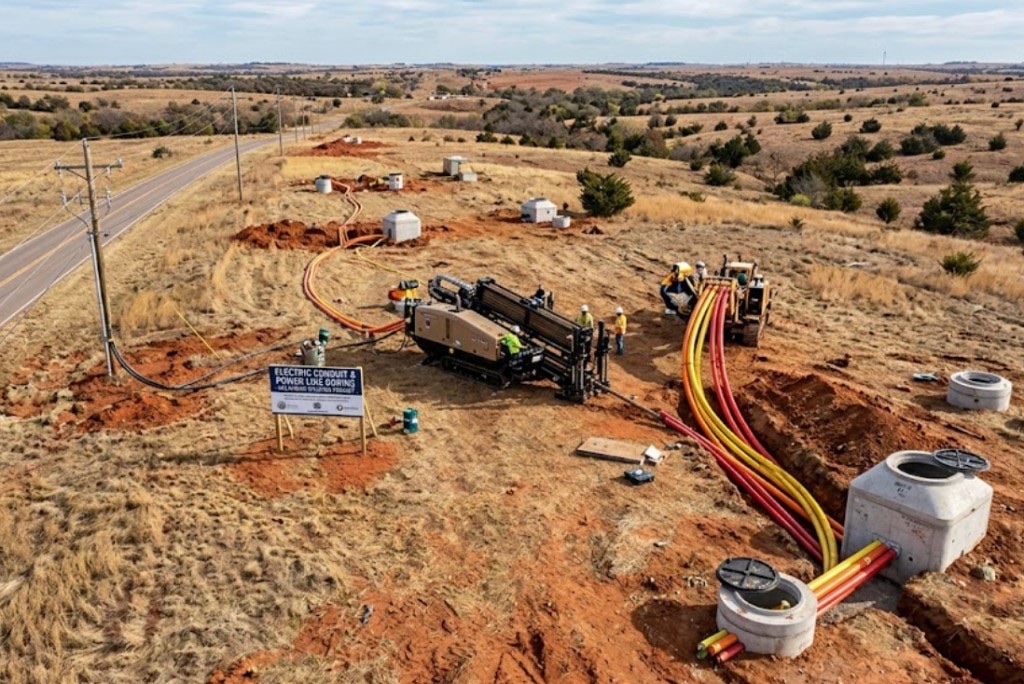
Horizontal directional drilling in Ponca City is how Highland Avenue and Grand corridor owners pull duct and water under frontage asphalt without closing lanes that serve lake tourism and Kay County retail. Lake Ponca alluvium and sandstone lenses change penetration rates on north approaches — steerable HDD with groundwater-aware mud beats open cut when saturated lake soils would stall a trench crew.
Directional boring in Ponca City on 14th Street and downtown stacks PSO distribution, city water, and gas shallow on Kay County ROW. Oklahoma One-Call tickets and potholes at paint conflicts come before rig mobilization — not after a pit is half dug in lake-bottom fill.
Directional drilling in Ponca City along US-60 and US-77 carries ODOT District 1 MOT and permit calendars that often outlast the physical bore. Enid and Bartlesville corridor GCs spec HDD when frontage restoration on alluvium-heavy ROW would burn TI budgets.
Real Kay County angles — not generic statewide copy.
Post-paving TI cannot trench the full parking aisle to reach switchgear. HDD links vaults under asphalt with pits offset from striping.
Spring saturation sheared PVC — steerable bore from meter to house entry without retrenching mature trees.
ODOT widening stacks relocations under state ROW. HDD narrows lane closure footprints — MOT scoped before mobilization.
Warehouse feed crosses sandstone lens between pads — cased approach ties into plant specs.
Ponca City HDD crews confirm survey and locate paint first — two business days minimum on One-Call before pits open, longer on US-60 ROW. Entry pits account for lake-adjacent groundwater; mud weight tuned when sandstone appears on industrial pulls. Pilot, ream, and pullback monitored for buoyancy on long HDPE through Kay County fill.
Kay County sandy loam, red dirt, and sandstone with lake-bottom alluvium — variable bearing unlike central red-clay metro with groundwater on Lake Ponca approaches.
Ponca City bores encounter Kay County sandy loam with red dirt and sandstone lenses — penetration changes on Highland commercial approaches and Lake Ponca lowlands. Groundwater near the lake raises buoyancy risk on long HDPE pulls. East toward the county line, tighter shale can slow penetration without correct bit selection.
Northeast Oklahoma humidity with Kay County prairie wet-dry cycles — spring storms soften lake-adjacent ROW; summer heat on long US-60 pulls.
Spring storms on Lake Ponca lowlands are Ponca City's biggest calendar variables — saturated approaches delay entry work briefly. Summer heat affects long US-60 pulls. Lightning holds stop rigs during severe weather. We plan bore windows around known wet seasons rather than forcing pits into unstable lake banks.
City of Ponca City Engineering, Kay County ROW, ODOT District 1 on US-60 and US-77, lake and river floodplain on select routes.
City of Ponca City permits street and drive work inside limits. Kay County ROW on rural US-60 and US-77 approaches. ODOT District 1 controls state highway bores. Lake and river floodplain work may need environmental review — scoped per alignment, not assumed on every quote.
Open-cut across Highland parking or a lake-area berm often costs more in asphalt, tree restoration, and business interruption than the bore. HDD wins when alluvium blocks shallow trench or when ODOT ROW limits trench width — open prairie north may still trench on price.
Footage, diameter, clay versus rock, dewatering, traffic control, permit fees, utility density, and rig class — quoted as drivers, not a menu price.
You share plans or describe the problem; we confirm alignment, depth, access, and which trenchless method fits Oklahoma soils.
Oklahoma One-Call ticket filed; two business days minimum before pits open unless your permit path differs. We pothole where marks conflict.
Bore plan, ODOT or city ROW permits, railroad agreements, and crossing engineering when the path leaves private property.
Compact spread for tight Edmond lots; larger HDD for I-35 or I-40 relocations — matched to length and diameter.
Steered pilot on design line, ream passes sized for your pipe or casing, fluid program tuned for clay or sand lenses.
HDPE fusion, steel casing, or multi-duct bundle pulled with tension and bend-radius monitoring.
Pressure test, mandrel, or survey records for owners, inspectors, and operators as spec requires.
Compact pits, replace sod or hardscape per scope, leave 811 ticket and locate map in your project file.
Length, diameter, alluvium or sandstone, groundwater, utility density, and MOT — not a flat per-foot rate. Highland duct, lake lateral, and US-60 relocation use different spreads. Send alignment.
Yes — mud weight and groundwater planning manage alluvium risk; saturated banks may delay entry — we say so before booking steel.
Two full business days after ticket submission. Highland commercial corridors often need remark and hand holes at PSO conflicts.
Yes — Kay County mobilization; permits and tap rules vary by address.
Bank-adjacent alignments need seasonal planning — scoped per route.
24/7 — Emergency dispatch statewide. Tell us entry, exit, pipe size, and county — a bore specialist calls back with cost drivers, not a flat rate.
Scope your bore path
Step 1 of 2 — path, pipe, and city first